
Diagnostics
Autokeratorefractometry
Autokeratorefractometry is a method that enables automatic determination of objective refraction.
Autokeratorefractometry
What is autokeratorefractometry?
This is usually the first diagnostic examination, the initial method when determining the refraction (diopter). The device automatically measures the diopter for a few seconds, after which the visual acuity is determined. For this examination, instillation of drops or dilation of the pupils is not necessary. However, it is usually repeated even after dilation of the pupils, due to possible spasm of accommodation. This examination is short, painless and is performed without touching the patient's eye.
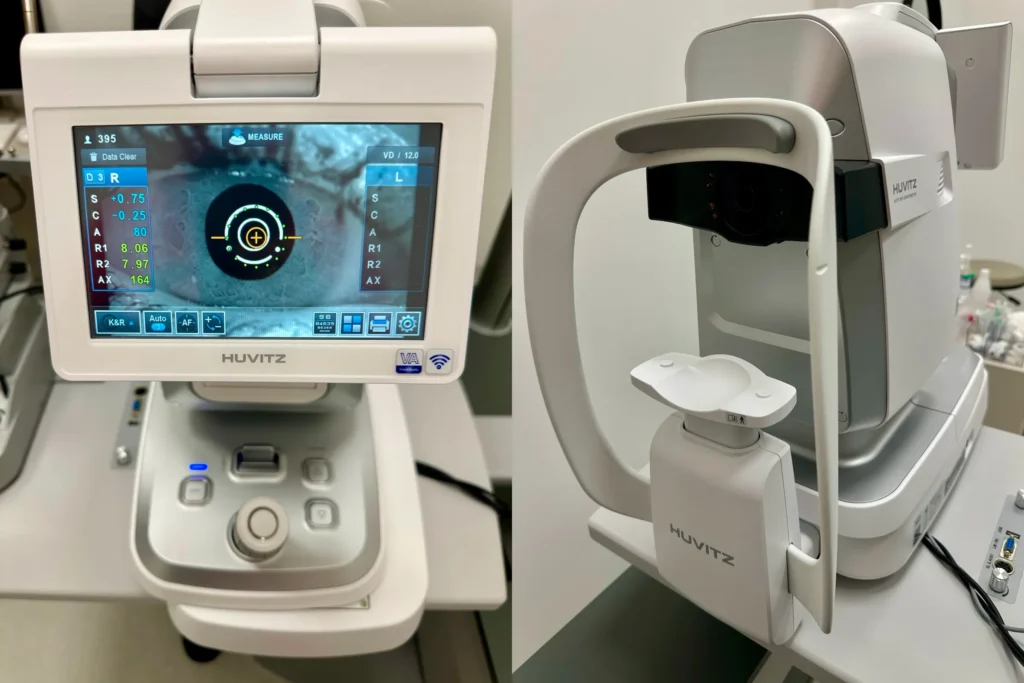
Technology in the Ophthalmology Center
The best equipment on the market
The state-of-the-art HRK-9000A model that we have, in addition to the basic function of keratorefractometry, also has numerous other possibilities:
- Tear Film Stability Assessments (TFBUT) which allows for a more comprehensive understanding of patients' vision and evaluation of the tear film
- Meibomography/observation of the state of the Meibomian glands, which is of great importance for the diagnosis of dry eye. Meibomian gland degeneration can also be monitored with a sufficient light source and image enhancement function
- It is possible to gain insight into the condition of the lens (lenticular opacity in cataract patients) or corneal injury caused by wearing contact lenses. The full-color CCD camera and white LED light source in the automatic ref-keratometer allow assessment of contact lens fitting status, which was previously only possible with slit lamps.
- Comparison of subjective and objective tests of visual acuity (VO) provides more reliable and accurate data. A subjective visual acuity test is useful in deciding the need for progressive lenses because it checks the visual acuity based on the patient's response.
- Very reliable night vision acuity can be tested with a low contrast sensitivity test and a glare test that perfectly reproduces the halo effect.
- The contact lens fitting guide allows you to see the fluorescein liquid with blue illumination in the automatic ref/keratometer and thus easier to see the position of the contact lens. Continuous measurement on the periphery of the cornea at an angle of 90˚ and vertically and horizontally from the center of the cornea produces the curvature and eccentricity values of all points and allows the best fitting of the contact lenses.
- An additional measurement mode for IOL power or visual acuity after cataract surgery is also available.
- Measurement of iris and pupil diameter
- The image recording function supports a very precise examination by measuring the diameter of the iris and pupil from 2 mm to 14 mm.