
Diagnostics
Computerized visual field
Computerized visual field is a precise diagnostic method that measures and analyzes peripheral and central vision to detect changes in the visual field associated with various eye and neurological conditions.
Diagnostics
What is computerized field of vision?
This non-invasive method uses a specialized device that displays points of light on a screen, and the patient notes when they notice them. Based on this data, the computer creates a map of the visual field, enabling the identification of narrowing or other visual impairments.
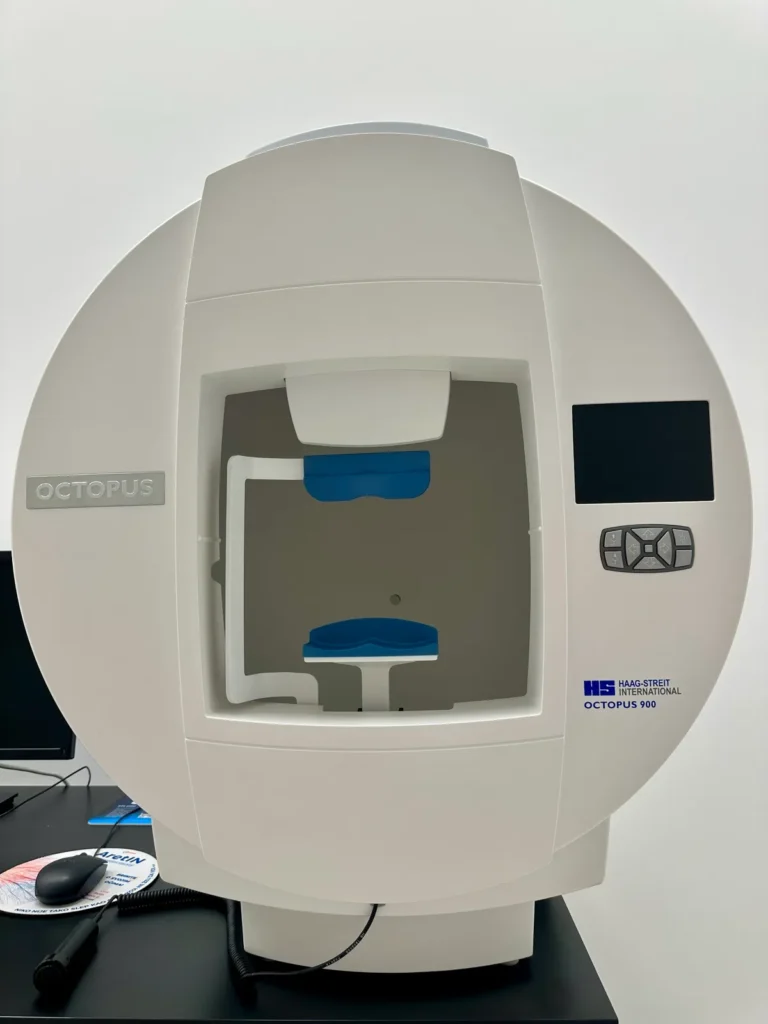
Our field of view device (Octopus 900 Pro) is the latest generation of the renowned Swiss company Haag-Streit.
It offers the possibility to test numerous conditions in which it is necessary to look at the state and width of the visual field, from detailed ophthalmological and neurological programs to programs for rapid assessment of the state of the visual field (screening).
At the same time, this device enables both static and kinetic perimetry. Due to the special Goldman dome, complete peripheral testing of the field of vision is possible up to 90° temporally, up to 60° up and nasally, and up to 70° down.
It also offers a comprehensive library of static tests for full and central field applications, including special test patterns for macular degeneration, blepharoptosis and neurological testing.
The Octopus 900 automatically recognizes loss of fixation and adjusts to patients until optimal examination conditions are achieved.
TOP and kinetic strategies
Rapid testing strategies
TOP and kinetic strategy test the central field in just 2-4 and 6-8 minutes respectively. While the TOP strategy is a fast, automated testing algorithm that drastically reduces examination time, often to less than three minutes, making it more convenient for the patient. The kinetic strategy is better suited for identifying small, isolated defects.
Driving tests
Binocular driving assessment
A patient's driving ability is usually assessed with the standard binocular Esterman test, which is widely recognized as the standard for visual driving ability. Alternatively, the Octopus 900 pro also offers a European driving test, in accordance with EU requirements.
SAP and low vision
Testing flexibility
The Octopus 900 provides complete testing flexibility. In addition to standard white-on-white perimetry with Goldman III stimulus, it also offers V-sized Goldman stimulus for low-vision patients, as well as blue-on-yellow and flicker perimetry for early detection of glaucoma.
Cluster analysis/trend
Sensitive glaucoma analysis
The sensitive cluster trend groups visual field defects along nerve fiber bundles and combines high sensitivity with good specificity for detecting early glaucomatous changes.
Octopus 900 allows viewing a series of glaucoma visual fields from different angles.
Basic characteristics:
- Full 90° field of view
- Static and Goldmann kinetic perimetry
- Blue-on-yellow perimetry (SWAP)
- Flicker perimetry
- Driving test (monocular/binocular)
Benefits
Why check regularly?
- Precise detection of visual field impairment
- Non-invasive and painless procedure
- Key for diagnosis and monitoring of ophthalmic and neurological disorders
- It helps in the early detection of problems that are not visible with a simple examination
Who is the diagnosis for?
Who should get tested?
Ideal candidates are:
- Patients with suspected glaucoma or other optic nerve diseases
- People with neurological diseases that can affect vision
- Patients with complaints of loss of peripheral vision or visual disturbances
- People who are being monitored for the progression of retinal or optic nerve disease
Frequently asked questions
Worried?
Does the examination hurt?
No, the examination is completely painless.
Do I need to take off my glasses?
Usually the examination is done with glasses if the patient wears them.